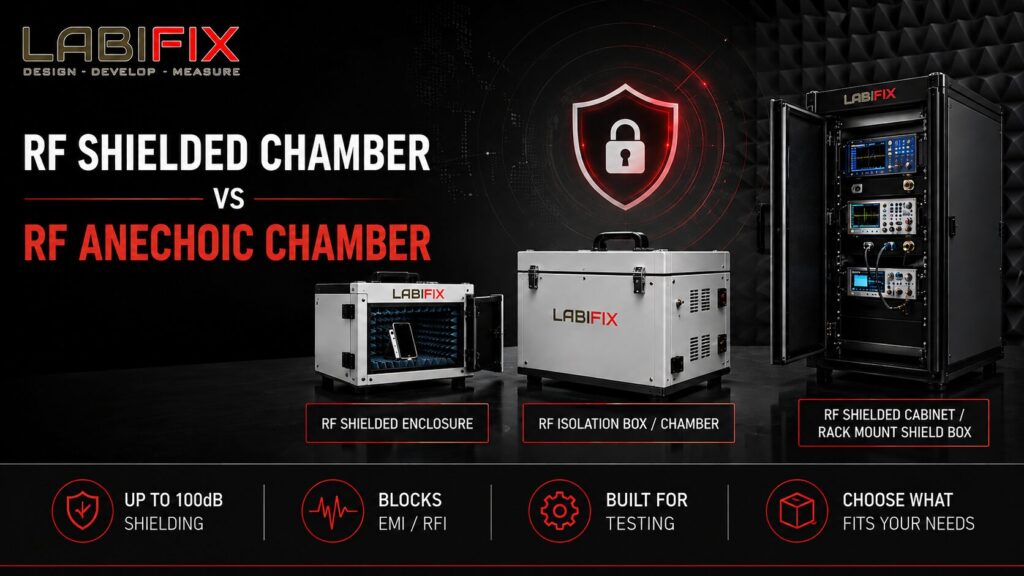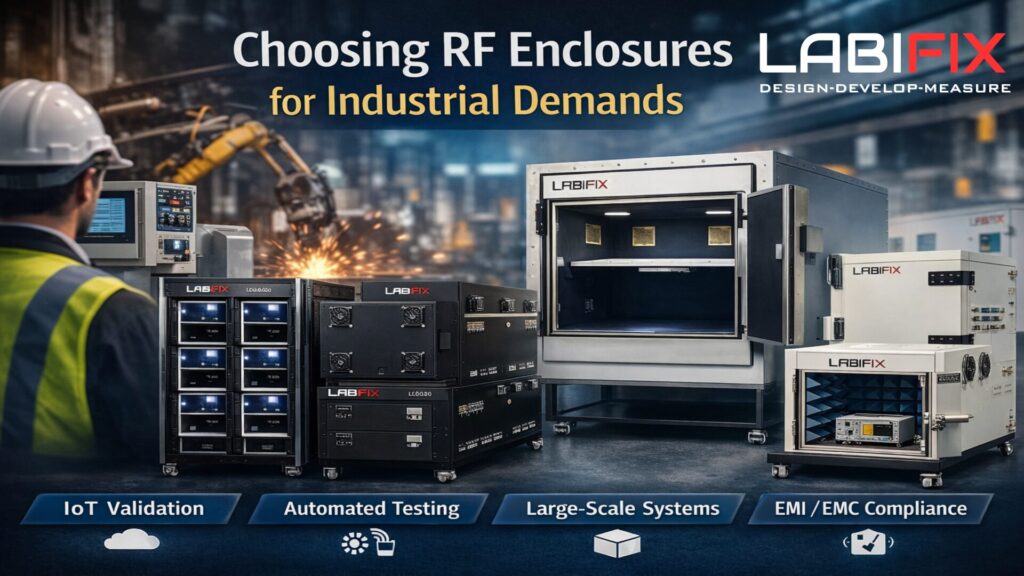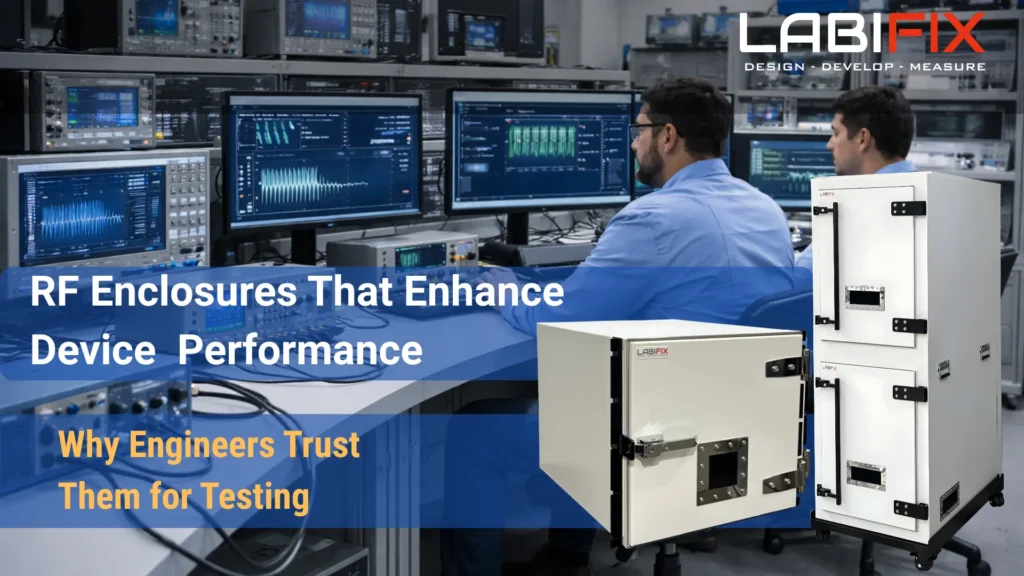
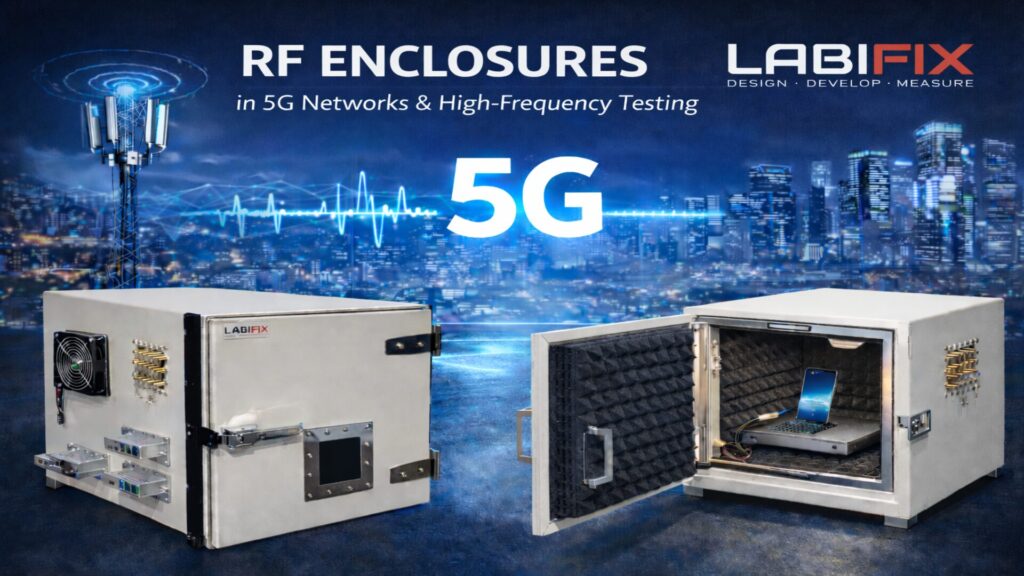
Advanced RF shield boxes and test enclosures built for reliable wireless testing.
The transition to 5G is more than faster download speeds—it represents a fundamental evolution in wireless network design and device performance expectations. With higher operating frequencies (including mmWave), denser network deployments, and stringent signal integrity requirements, traditional test environments are no longer sufficient.
Accurate 5G validation now depends on controlled, interference-free RF environments. RF enclosures provide the isolation required to test devices, antennas, and modules with precision and repeatability. Labifix delivers a comprehensive range of RF shielding solutions, including 5G NR test enclosures and mmWave RF shield boxes, designed to support advanced wireless innovation across telecom, IoT, automotive, and research applications.
5G systems operate across a broad spectrum, including sub-6 GHz (FR1) and mmWave (FR2) bands. These frequencies are highly sensitive to environmental variables such as:
- Ambient Wi-Fi, LTE and 5G NR base-station emissions that raise the receiver noise floor in FR1 bands.
- Reflections and multipath from benches, walls and cabling that distort mmWave beam patterns between 24 GHz and 40 GHz.
- Interference from neighbouring test stations running Bluetooth, Wi-Fi 6E/7 and cellular radios.
- Small changes in cable loss and DUT position at 28 GHz and 39 GHz, which shift measured EIRP and sensitivity.
Without effective RF shielding, measurements in R&D and validation labs can be skewed by ambient noise, leading to unreliable results and extended development cycles. This is why controlled RF environments are not just beneficial—they are critical for accurate 5G performance validation.
RF enclosures act as high-performance Faraday cages that isolate the device under test (DUT) from external RF interference. At the same time, they:
- Keep DUT emissions inside the enclosure so they do not disturb other equipment in the lab.
- Provide more than 90 dB attenuation from 100 MHz to 12 GHz, with mmWave builds specified up to 40 GHz.
- Use RF absorber lining to damp internal reflections for repeatable over-the-air and throughput results.
- Pass power, USB, Ethernet and RF signals through filtered feedthroughs so the shield stays intact during testing.
Labifix RF enclosures combine high shielding effectiveness with robust construction and flexible I/O integration to support modern wireless test workflows.
Compact RF enclosures are ideal for R&D labs and development benches, supporting:
- 5G NR throughput, handover and sensitivity testing on sub-6 GHz modems and modules.
- Beamforming and antenna-in-package characterisation in FR2 mmWave bands.
- Wi-Fi 6E/7, Bluetooth LE and cellular coexistence testing.
- Pre-compliance screening ahead of formal conformance and carrier certification.
Browse benchtop RF shielded enclosures for compact lab use, or the LBX1505 compact manual RF test enclosure for wireless device testing. For larger setups, see RF shielded chambers or the full RF Shield Box catalogue, and request a quote for a configuration matched to your 5G test plan.
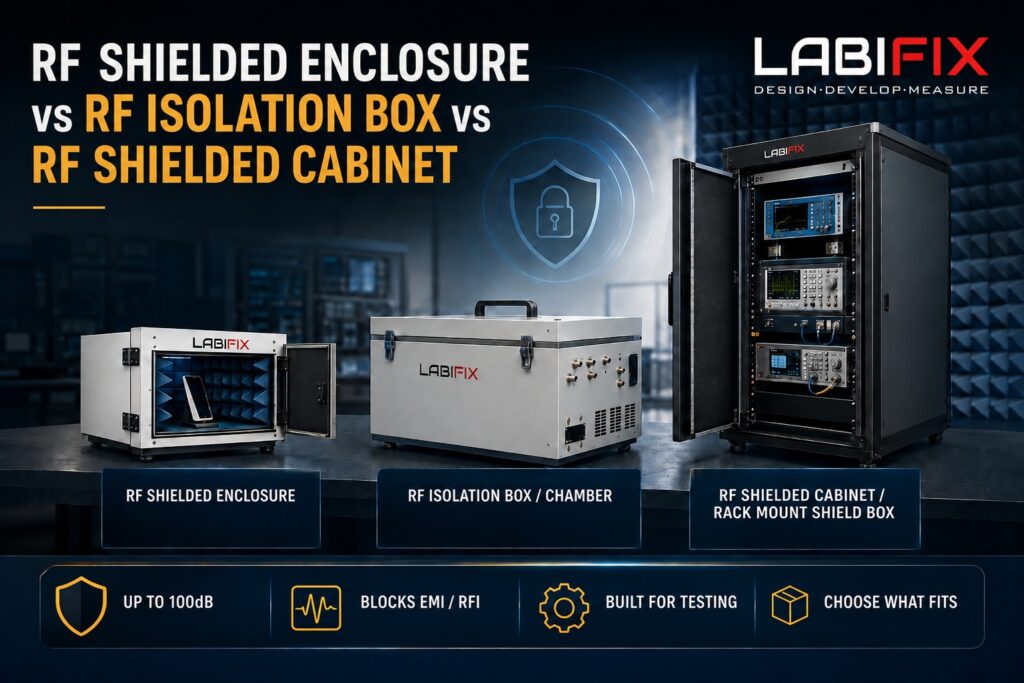
RF Shielded Enclosure vs RF Isolation Box vs RF Shielded Cabinet: Quick Comparison
| Term | Form Factor | Primary Focus |
|---|---|---|
| RF Shielded Enclosure | General-purpose test enclosure | General-purpose benchtop or standalone RF testing |
| RF Isolation Box / Faraday Box | Compact benchtop or portable test box | Portable / benchtop DUT wireless device testing |
| RF Shielded Cabinet | Rack-integrated 19-inch equipment cabinet | Rack-mounted test instruments & equipment gear |